Fewer maternity recipients, and more other-parent recipients per 100 of them
For children born in 2024, the EO (Erwerbsersatzordnung, the income compensation insurance) paid maternity leave to 65,054 people and other-parent leave to 62,560 people in all cantons plus abroad, according to the Federal Social Insurance Office (BSV). For children born in 2021, the first year of the other-parent leave, the figures for all cantons plus abroad were 73,794 and 67,215.
The EO pays a daily allowance to a mother who meets the conditions of the law, for 14 weeks after the birth, and to the other parent, the father or the mother's wife, for 2 weeks within 6 months. When your Helper has a child, the allowance comes from the EO through the compensation office. As the employer, your household grants the leave, passes the claim on and pays its share of the EO contributions.
In the 26 cantons together, without the recipients abroad, 91.3 people drew other-parent leave for every 100 who drew maternity leave for children born in 2024, against 87.5 in 2021. This ratio is not an uptake rate. It compares two different groups of people, and each person is counted only if they met the conditions for their own allowance.
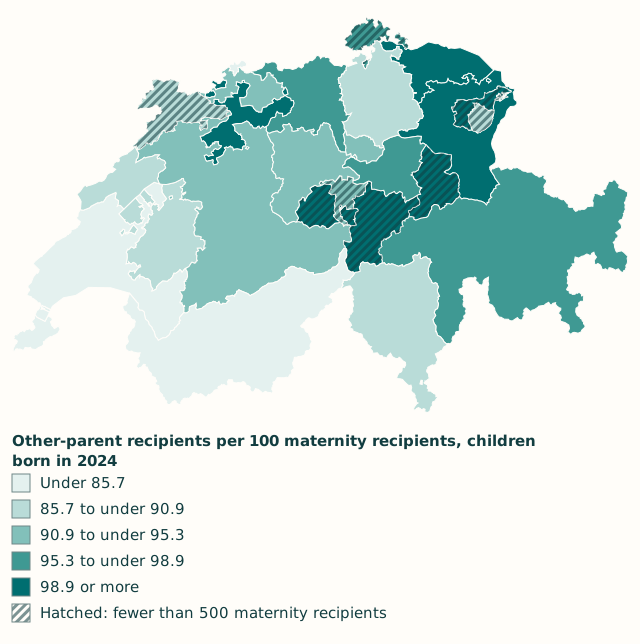
For children born in 2024, this ratio ranged from 78.3 in Geneva to 107.1 in Uri. Uri counted fewer than 500 maternity recipients, so a few people more or less move its ratio.
- Maternity leave recipients, children born in 202465,054All cantons plus abroad; 73,794 in 2021
- Other-parent leave recipients, children born in 202462,560All cantons plus abroad; 67,215 in 2021
- Other-parent recipients per 100 maternity recipients, 26 cantons without abroad91.387.5 in 2021. Not an uptake rate.
- Lowest and highest canton, 2024Geneva 78.3 · Uri 107.1Per 100 maternity recipients. Uri counted fewer than 500 maternity recipients.
Canton by canton
The canton is the canton the EO register records for the recipient; recipients living abroad are shown separately. The table does not say whether that is the canton where the person lives or works.
By canton
Pick a birth year and a measure. Select a canton on the map or in the list to see both leaves and its ratio from 2021 to 2024.
- Under 85.7
- 85.7 to under 90.9
- 90.9 to under 95.3
- 95.3 to under 98.9
- 98.9 or more
- Hatched: fewer than 500 maternity recipients
Other-parent recipients per 100 maternity recipients, children born in 2024
Use the arrow keys to move between cantons. Press Enter to see a canton's figures.
All cantons plus abroad
Children born in 2024
Maternity leave: 65,054 recipients
Other-parent leave: 62,560 recipients
Of these, living abroad: 5,291 maternity and 7,988 other-parent recipients
The 26 cantons together, without recipients abroad: 91.3 per 100
Show the table of all 26 cantonsHide the complete canton table
| Canton | Maternity leave recipients | Other-parent leave recipients | Other-parent recipients per 100 maternity recipients | Change in the ratio since 2021 |
|---|---|---|---|---|
| Zurich | 11,588 | 10,308 | 89.0 | rose by 3.8 |
| Bern | 6,880 | 6,401 | 93.0 | rose by 3.8 |
| Lucerne | 3,336 | 3,146 | 94.3 | fell by 2.0 |
| Uri * | 269 | 288 | 107.1 | rose by 9.0 |
| Schwyz | 1,146 | 1,109 | 96.8 | rose by 0.8 |
| Obwalden * | 258 | 259 | 100.4 | rose by 1.1 |
| Nidwalden * | 282 | 264 | 93.6 | rose by 1.5 |
| Glarus * | 261 | 264 | 101.1 | fell by 1.2 |
| Zug | 912 | 861 | 94.4 | rose by 2.9 |
| Fribourg | 2,612 | 2,363 | 90.5 | rose by 2.0 |
| Solothurn | 1,723 | 1,808 | 104.9 | rose by 9.3 |
| Basel-Stadt | 1,352 | 1,079 | 79.8 | rose by 2.8 |
| Basel-Landschaft | 1,781 | 1,622 | 91.1 | rose by 7.5 |
| Schaffhausen * | 499 | 493 | 98.8 | rose by 3.1 |
| Appenzell Ausserrhoden * | 364 | 364 | 100.0 | rose by 1.4 |
| Appenzell Innerrhoden * | 119 | 105 | 88.2 | fell by 19.0 |
| St. Gallen | 3,658 | 3,665 | 100.2 | rose by 2.4 |
| Grisons | 1,210 | 1,158 | 95.7 | rose by 0.6 |
| Aargau | 5,053 | 4,865 | 96.3 | rose by 6.0 |
| Thurgau | 1,963 | 2,058 | 104.8 | rose by 2.4 |
| Ticino | 1,681 | 1,512 | 89.9 | fell by 1.2 |
| Vaud | 5,659 | 4,661 | 82.4 | rose by 4.4 |
| Valais | 2,409 | 2,051 | 85.1 | rose by 3.2 |
| Neuchâtel | 1,102 | 978 | 88.7 | rose by 2.2 |
| Geneva | 3,190 | 2,498 | 78.3 | rose by 11.1 |
| Jura * | 456 | 392 | 86.0 | rose by 4.0 |
| The 26 cantons together, without recipients abroad | 59,763 | 54,572 | 91.3 | rose by 3.8 |
| Recipients living abroad | 5,291 | 7,988 | 151.0 | rose by 13.5 |
| All cantons plus abroad | 65,054 | 62,560 | 96.2 | rose by 5.1 |
Change in the ratio: the 2024 ratio minus the 2021 ratio, in points.
* Fewer than 500 maternity recipients for children born in 2024.
For children born in 2024, the fewest other-parent recipients per 100 maternity recipients were in Geneva 78.3, Basel-Stadt 79.8, Vaud 82.4 and Valais 85.1. The most were in Uri 107.1, Solothurn 104.9, Thurgau 104.8 and Glarus 101.1. Among the cantons with at least 500 maternity recipients, Solothurn had the highest ratio, 104.9.
In 7 cantons, at least as many people drew other-parent leave as maternity leave: Uri, Obwalden, Glarus, Solothurn, Appenzell Ausserrhoden, St. Gallen and Thurgau. From 2021 to 2024, the ratio rose in 22 of the 26 cantons. It fell in Appenzell Innerrhoden, Lucerne, Glarus and Ticino.
Uri, Obwalden, Nidwalden, Glarus, Schaffhausen, Appenzell Ausserrhoden, Appenzell Innerrhoden and Jura each counted fewer than 500 maternity recipients for children born in 2024, so read their figures with care.
A ratio per 100 maternity recipients is not an uptake rate
The BSV publishes its own uptake rate (Bezugsquote) for the maternity leave and the other-parent leave. It links the births of the population register with the accounts of the AHV (old age and survivors' insurance) and the EO register, checks who could claim, and leaves out recipients living abroad. The ratio in this study does none of that. It only sets two counts from the same table side by side, so it is not the BSV uptake rate and cannot be compared with it.
A mother who does not meet the conditions of the law draws no maternity allowance, while the other parent may draw theirs. The reverse also happens. Each leave counts only the people who drew it, so a canton can show more other-parent recipients than maternity recipients.
Abroad, more people drew other-parent leave than maternity leave in every year from 2021 to 2024: 7,988 against 5,291 for children born in 2024, or 151.0 other-parent recipients per 100 maternity recipients. The BSV describes recipients abroad as cross-border commuters.
Maternity recipients peaked for children born in 2021
In all cantons plus abroad, maternity recipients went from 69,400 for children born in 2020 to 73,794 in 2021, the peak of the series, and to 65,054 in 2024, 11.8% fewer than in 2021. From 2021 to 2024, the number fell in every canton. In all cantons plus abroad, other-parent recipients fell by 6.9%, from 67,215 to 62,560.
The table counts the leaves paid, not the births, so it does not show why the numbers moved.
- Maternity leave: 65,054 recipients
- Other-parent leave: 62,560 recipients
| Birth year | Maternity leave | Other-parent leave |
|---|---|---|
| 2020 | Maternity leave: 69,400 recipients | Other-parent leave began in 2021 |
| 2021 | Maternity leave: 73,794 recipients | Other-parent leave: 67,215 recipients |
| 2022 | Maternity leave: 67,640 recipients | Other-parent leave: 62,635 recipients |
| 2023 | Maternity leave: 65,592 recipients | Other-parent leave: 62,902 recipients |
| 2024 | Maternity leave: 65,054 recipients | Other-parent leave: 62,560 recipients |
Rounded to whole days, the other-parent leave averaged 14 days in every canton and every year from 2021 to 2024, the 14 daily allowances the law provides. The maternity leave averaged between 98 and 100 days. The law pays the maternity allowance on more than 98 days in some cases, for example when the newborn stays in hospital after the birth (EOG Art. 16c), so an average can exceed 98 days.
In all cantons plus abroad, the average daily allowance for children born in 2024 was CHF 143 for maternity leave and CHF 182 for other-parent leave, against CHF 131 and CHF 169 in 2021. By canton, the average maternity allowance was highest in Geneva, at CHF 164 a day, and lowest in Uri, at CHF 118. The allowance follows the earnings before the birth, up to the maximum.
For children born in 2025, the table holds provisional figures only: 65,382 maternity recipients and 63,228 other-parent recipients in all cantons plus abroad. A birth year is final once the BSV reads the register at the end of April two years after it. For the latest year, the BSV reads the register at the end of September of the following year and estimates the final count from it. This study therefore ends its canton series at 2024, the latest final year.
What the EO pays when your Helper has a child
A parent who was insured before the birth and was employed, self-employed or drawing unemployment benefit can claim, under the conditions of the EOG and the EOV (EOG Art. 16b and 16i, EOV Art. 29 and 30):
- maternity allowance: 80% of the average earnings before the birth, at most CHF 220 a day, for 98 days in a row from the day of the birth (EOG Art. 16c, 16e and 16f);
- other-parent allowance: 80% of the average earnings before the birth, at most CHF 220 a day, for at most 14 daily allowances, taken within 6 months of the birth as whole weeks or as single days (EOG Art. 16j, 16k and 16l).
The maximum of CHF 220 a day applies in 2026, and a federal ordinance keeps it at that amount in 2027. The other parent is the father or, since 1 July 2022, the mother's wife.
The leave itself is set in the Code of Obligations: at least 14 weeks of maternity leave after the birth (OR Art. 329f), and 2 weeks of other-parent leave, taken within 6 months of the birth (OR Art. 329g).
What your household does as the employer
A household that pays someone to work in its home is that person's employer. The employer is the household where the Helper works and that decides what work is done there, when and how. When your Helper has a child, your household:
- grants the leave: at least 14 weeks of maternity leave, or 2 weeks of other-parent leave within 6 months of the birth;
- passes the claim on: an employed parent claims through the employer, with form 318.750 for maternity leave or form 318.747 for other-parent leave, sent to your household's compensation office;
- pays the wage or lets the office pay: if your household keeps paying the wage during the leave, the compensation office pays the allowance to your household; otherwise it pays your Helper directly;
- settles the contributions: the allowance counts as wage for the AHV, the IV (disability insurance), the EO and unemployment insurance. When the allowance is paid to your household, you settle it with the compensation office like a wage, and the office refunds the employer contributions on it (EOV Art. 37).
The EO is financed by contributions on wages. On every wage your household pays, the EO contribution is 0.5%: 0.25% from your household and 0.25% deducted from your Helper's wage. It is part of the AHV, IV and EO contributions that your household pays to the compensation office of its canton. Give your Helper a payslip with every payment. Cover for accidents at work is required from the day the work starts. The employer check shows which of your duties are in place and which are still to do.
The guide for a household whose Helper is pregnant covers notice, sick pay and the documents to prepare. The family allowance study shows what a Helper with children receives in each canton.
If your Helper already works for you, Helpore has two plans. With Helpore Admin Light, the payslips and documents are ready every month, and you register, file and pay yourself. With Helpore Admin, registration, insurance, payroll and payments are done in your name, with one bill a month. Helpore Admin Light and Helpore Admin are optional, and your household stays the employer. Your Helper does not need a public profile or a Helpore account.
“A pregnancy is not a reason to end an employment. The sooner a household knows what the law asks of it, the calmer the months ahead are for its Helper and for the family.”
What the figures do not show
- The figures count people who drew an allowance, not births and not everyone who could claim. A parent who had no paid work before the birth and drew no unemployment benefit or sickness allowance has no claim and is not counted.
- The ratio per 100 maternity recipients compares two groups of different people. It is not the BSV uptake rate, and it is not a share of fathers.
- The canton is the one the EO register records for each recipient. The table does not say whether that is where the person lives or works.
- The latest birth year in the table is provisional, so the canton series end at 2024, the latest final year.
- The statistics do not show why cantons differ. Differences may reflect who is employed before a birth, where people work and how often parents claim.
Method and data
The figures come from the EO statistics of the Federal Social Insurance Office (BSV), published in the PxWeb database of the Federal Statistical Office as table px-x-1304070000_102. The study uses the number of recipients, the average number of days and the average daily allowance per person, for maternity leave and for other-parent leave, all nationalities, by canton and by birth year of the child.
The canton is the canton the EO register records for the recipient; recipients living abroad are shown separately. The table's metadata does not say whether that is the canton where the person lives or works. The table's total is all cantons plus abroad. In every year from 2020 to 2024, the 26 cantons and the recipients abroad add up to that total for the maternity leave, and from 2021 for the other-parent leave too.
The BSV counts each birth year from the register at the end of April two years later. For the latest birth year it uses the register at the end of September of the following year and projects maternity and other-parent leave. That year is provisional, so the study gives only its total for all cantons plus abroad and ends every canton series at 2024, the latest final year. An allowance not yet drawn can still be claimed for up to 5 years (EOG Art. 20), so a final year may still change a little.
The ratio is the number of other-parent recipients divided by the number of maternity recipients in the same canton and birth year, times 100, rounded to one decimal. The change in the ratio is the 2024 ratio minus the 2021 ratio, computed before rounding. A change in % is the later count minus the earlier count, divided by the earlier count, rounded to one decimal. The ratio of the 26 cantons together leaves out the recipients abroad.
A canton with fewer than 500 maternity recipients in a birth year is marked as small numbers for that year.
The other-parent leave began in 2021 as paternity leave, so its series start with children born in that year. The table also holds care leave and adoption leave; their canton cells are not published (not yet collected or not yet computed), so the study leaves them out. The legal figures come from the EOG, the EOV and the OR in the versions named in the sources.
Use the study data
The files use the same federal figures as the article, the canton map and the chart.
- Download the data (CSV)CSV · 8 KB
- Download the data definitionsMD · 2 KB
- Download the methodMD · 3 KB
- Download the canton map (SVG)SVG · 53 KB
Source: Federal Social Insurance Office (BSV), EO statistics.
The study text, the datasets we built and the charts we drew are under CC BY 4.0, so you may reuse them with attribution. The official source material stays under its own terms.
Frequently asked questions
What does the EO pay when my Helper has a child?
For maternity leave, 80% of the average earnings before the birth, at most CHF 220 a day, for 98 days from the birth. For other-parent leave, 80% of the average earnings, at most CHF 220 a day, for at most 14 daily allowances within 6 months of the birth. The maximum is the one in force in 2026 (EOG Art. 16f).
Who pays the allowance out, my household or the compensation office?
The compensation office. If your household keeps paying the wage during the leave, the office pays the allowance to your household; otherwise it pays your Helper directly. The allowance counts as wage, so AHV, IV, EO and unemployment insurance contributions are due on it.
What do I have to do as the employer?
Grant the leave and pass the claim on to your compensation office: form 318.750 for maternity leave, form 318.747 for other-parent leave. On every wage, your household also pays the EO contribution of 0.5% to the compensation office: 0.25% is your household's share and 0.25% is deducted from your Helper's wage.
How many people drew maternity leave from the EO?
For children born in 2024, 65,054 people in all cantons plus abroad drew maternity leave. That is 11.8% fewer than the 73,794 in all cantons plus abroad for children born in 2021. For the children born in 2024, 62,560 people in all cantons plus abroad drew other-parent leave.
Is the number of other-parent recipients per 100 maternity recipients an uptake rate?
No. It sets the other-parent recipients beside the maternity recipients of the same canton and birth year. They are different people, and each person is counted only if they met the conditions for their own allowance. The BSV publishes a separate uptake rate (Bezugsquote) that links births with the AHV accounts and the EO register; it is built differently, so the two cannot be compared.
Which canton has the fewest other-parent recipients per 100 maternity recipients?
Geneva, with 78.3 for children born in 2024, against 91.3 in the 26 cantons together without the recipients abroad. The highest ratio was in Uri, 107.1, but Uri counted fewer than 500 maternity recipients, so a few people more or less move its ratio.
Sources
- BSV, EO statistics, "Leistungen der Erwerbsersatzordnung (EO) bei Elternschaft nach Leistungsart, Kanton, Staatsangehörigkeit (Kategorie) und Geburts- bzw. Adoptionsjahr des Kindes bzw. erstem Tag des Leistungsbezugs (Betreuungsurlaub)", PxWeb table px-x-1304070000_102, in German. https://www.pxweb.bfs.admin.ch/pxweb/de/px-x-1304070000_102/px-x-1304070000_102/px-x-1304070000_102.px (API https://www.pxweb.bfs.admin.ch/api/v1/de/px-x-1304070000_102/px-x-1304070000_102.px). Read 1 November 2026.
- BSV, Statistik der Erwerbsersatzordnung EO, with the uptake rate (Bezugsquote) of maternity and other-parent leave, in German. https://www.bsv.admin.ch/de/statistik-eo. Read 1 November 2026.
- BSV, details of the data and the method of the uptake rate, in German. https://www.bsv.admin.ch/dam/de/sd-web/mqLFmkkhC8H0/Details%20zu%20den%20Daten%20und%20zur%20Datenaufbereitung%20der%20Bezugsquote%20des%20Mutterschaftsurlaubs%20und%20des%20Urlaubs%20des%20anderen%20Elternteils.pdf. Read 1 November 2026.
- Federal Act on Income Compensation (EOG, SR 834.1), Art. 16b to 16f, 16i to 16l, 20 and 27, version in force since June 2026, in German. https://www.fedlex.admin.ch/eli/cc/1952/1021_1046_1050/20260601/de. Read 1 November 2026.
- Federal ordinance on the adjustments to wage and price developments in the AHV, IV and EO (AS 2026 542), Art. 7, in German. https://www.fedlex.admin.ch/eli/oc/2026/542/de. Read 1 November 2026.
- Income Compensation Ordinance (EOV, SR 834.11), Art. 29, 30, 36 and 37, version in force since June 2026, in German. https://www.fedlex.admin.ch/eli/cc/2005/187/20260601/de. Read 1 November 2026.
- Swiss Code of Obligations (OR, SR 220), Art. 329f and 329g, in German. https://www.fedlex.admin.ch/eli/cc/27/317_321_377/20261001/de. Read 1 November 2026.
- Swiss Civil Code, amendment on marriage for all (AS 2021 747), Art. 255a, in German. https://www.fedlex.admin.ch/eli/oc/2021/747/de. Read 1 November 2026.
- AHV and IV information centre, leaflet 2.01, contributions on wages to the AHV, IV and EO, in German. https://www.ahv-iv.ch/p/2.01.d. Read 1 November 2026.
- AHV and IV information centre, leaflet 6.02, maternity allowance, in German. https://www.ahv-iv.ch/p/6.02.d. Read 1 November 2026.
- AHV and IV information centre, leaflet 6.04, allowance for the other parent, in German. https://www.ahv-iv.ch/p/6.04.d. Read 1 November 2026.
- AHV and IV information centre, form 318.750, claim for the maternity allowance, and form 318.747, claim for the allowance of the other parent, in German. https://www.ahv-iv.ch/p/318.750.d and https://www.ahv-iv.ch/p/318.747.d. Read 1 November 2026.