Under those conditions, a cleaner employed directly by a Zurich household would retain a CHF 23.90 hourly minimum, compared with CHF 20.29 for an unskilled hairdresser in the first year and CHF 22.10 for hospitality category Ia, including kitchen work within that category. The comparison concerns the legal wage floor, using the selected full-year 2026 profiles. It does not predict a change in anyone’s actual pay.
Zurich’s municipal minimum is still pending
Zurich has adopted a municipal minimum of CHF 23.90, but it is not yet in force as of 4 October 2026. Its commencement date remains open. The ordinance does not contain a general exemption for employment covered by a NAV or GAV; personal and other exceptions still matter. Our model uses a worker aged 25 or older. City of Zurich · Adopted ordinance, Article 2
The household distinction can also be illustrated in Zurich, under an explicit scenario. If the municipal minimum applies, the federal GAV priority takes effect without a transition preserving that municipal amount, and the selected rates remain at their published 2026 levels, the direct household profile would retain the CHF 23.90 municipal floor while the selected GAV categories could have lower minima.
For the first-year unskilled hairdresser, the 2026 comparison is CHF 20.29 per paid hour: CHF 3.61 below Zurich’s published municipal amount. This is a frozen-rate scenario, not a prediction of a future salary or a pay cut. The same conditions apply to the other sector comparisons below.
Study
Zurich: a published reference beside sector rates
Zurich’s minimum is not yet in force. This assumes it starts and the reform allows lower collective-agreement minima without preserving the municipal amount. Start date and transition protection remain unresolved.
CHF gross per paid hour
Published 2026 amounts, worker aged at least 25, no exception and full-year employment. Mandatory thirteenth month included, holiday and public-holiday uplifts excluded. Hourly normalization uses 43 hours × 52 weeks for hairdressing and 42 hours × 52 weeks for hospitality. Cleaning: 21.40 × 13 ÷ 12. Zurich commencement and municipal transition remain unresolved. This comparison does not predict the future applicable wage or a pay cut.
Sources: City of Zurich and adopted ordinance, hairdressing, hospitality and German-Swiss cleaning agreements. Calculation: Helpore. Checked October 4, 2026.
Show the data table
| Zurich: a published reference beside sector rates | CHF gross per paid hour |
|---|---|
| Zurich municipal reference | 23.90 |
| Hairdressing, unskilled first year | 20.29 |
| Hospitality Ia, ordinary 42-hour week | 22.10 |
| Maintenance cleaning I | 23.18 |
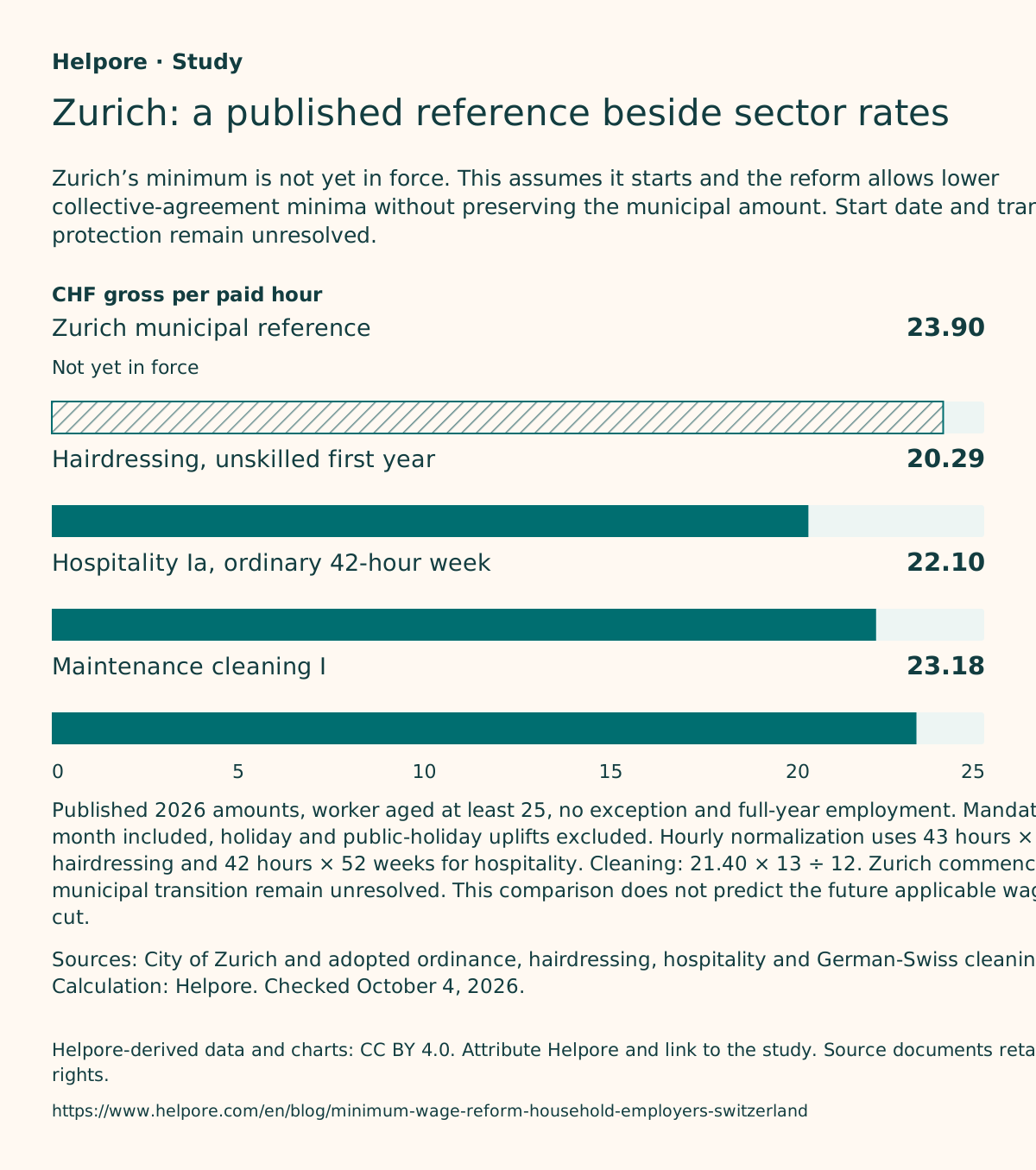
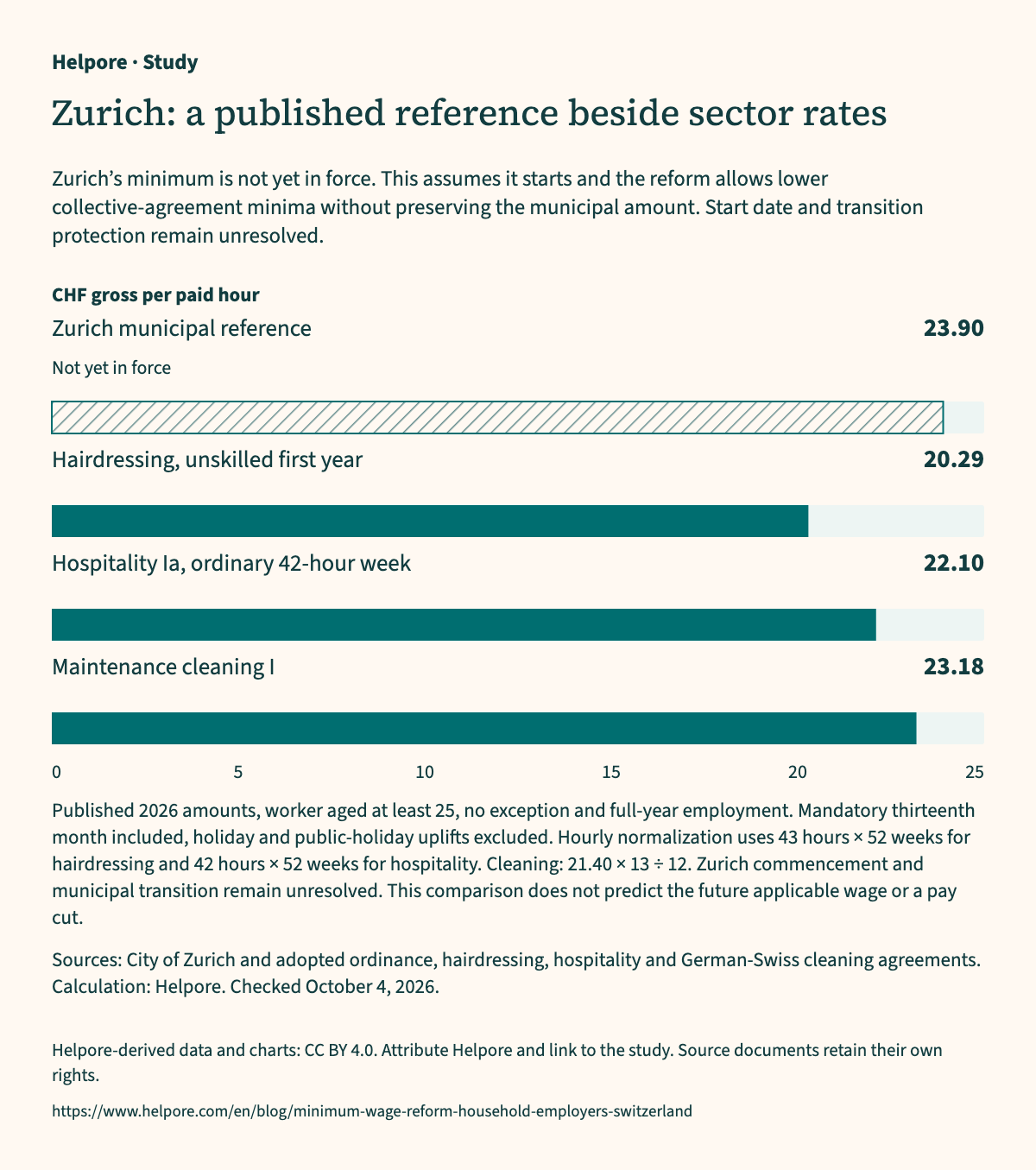
Comparison basis: published 2026 rates, full-year employment, mandatory thirteenth month included, holiday and public-holiday uplifts excluded. We do not model a hospitality introduction-period reduction or special weekly-hours category. Hairdressing agreement · Hospitality 2026 rates · Cleaning agreement
An additional legal question remains: how the amendment’s transition would apply to a municipal minimum already in force before the federal change. The adopted text does not expressly resolve that municipal case. This uncertainty can concern Zurich and Winterthur as well as Lucerne.
The minimum-wage reform would treat some household employees differently from workers covered by generally binding collective agreements. The important distinction is whether their wage floor can continue to be indexed.
If the amendment enters into force, directly employed cleaners covered by Geneva’s or Neuchâtel’s cantonal minimum would retain its ordinary indexation. For affected collective-agreement jobs, the transition would preserve the nominal amount at commencement until the agreement’s minimum overtakes it, without later cantonal indexation.
This is Helpore’s reading of the adopted law and current cantonal rules. We compared the legal mechanisms and selected published wage rates. It is a specific difference in minimum-wage protection, not a comparison of every employment right or actual earnings.
Geneva and Neuchâtel: indexation is the dividing line
The amendment gives minimum-wage provisions of generally binding collective agreements priority over contrary cantonal rules. Its transition protects certain already-prevailing cantonal minimums, but fixes the preserved amount at the specified commencement point. The National Council committee’s explanation expressly distinguishes that nominal protection from continuing cantonal indexation. Adopted amendment, Article 1 · Committee explanation
The directly employed household-cleaner profile considered here is governed by household employment rules rather than a generally binding cleaning-company agreement. The amendment does not change the federal household NAV itself. For a cleaner covered by the ordinary cantonal minimum in Geneva or Neuchâtel, the cantonal indexation rules would therefore continue to apply. Their effect depends on the index: retaining indexation does not guarantee an increase every year. Geneva: scope · Geneva: indexation · Neuchâtel: scope and annual adjustment
| Employment covered by the relevant rules | If the amendment enters into force |
|---|---|
| Cleaner employed directly by a household, covered by Geneva’s or Neuchâtel’s ordinary cantonal minimum | The cantonal minimum and its ordinary indexation continue to apply. |
| Job covered by a generally binding collective agreement, where the transition preserves a higher cantonal minimum | The amount at commencement stays applicable until the agreement minimum exceeds it. Later cantonal indexation is not carried forward for that job. |
This comparison assumes the cantonal minimum covers the employment and no personal or sector exception applies. Qualifications, experience and any higher agreed wage still matter. The future commencement amount is not known. Geneva household categories · Neuchâtel employment law
Geneva shows what indexation has meant
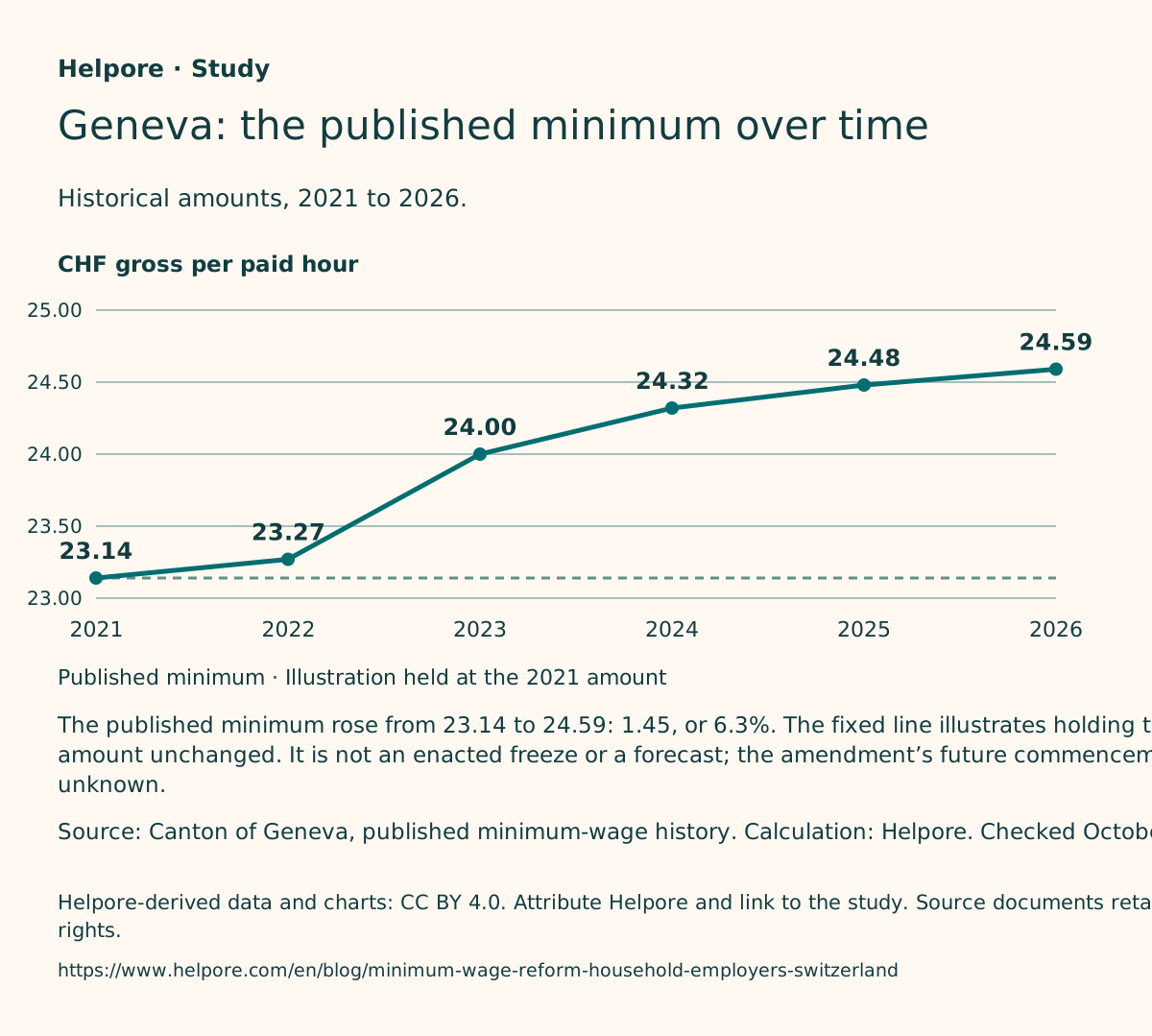
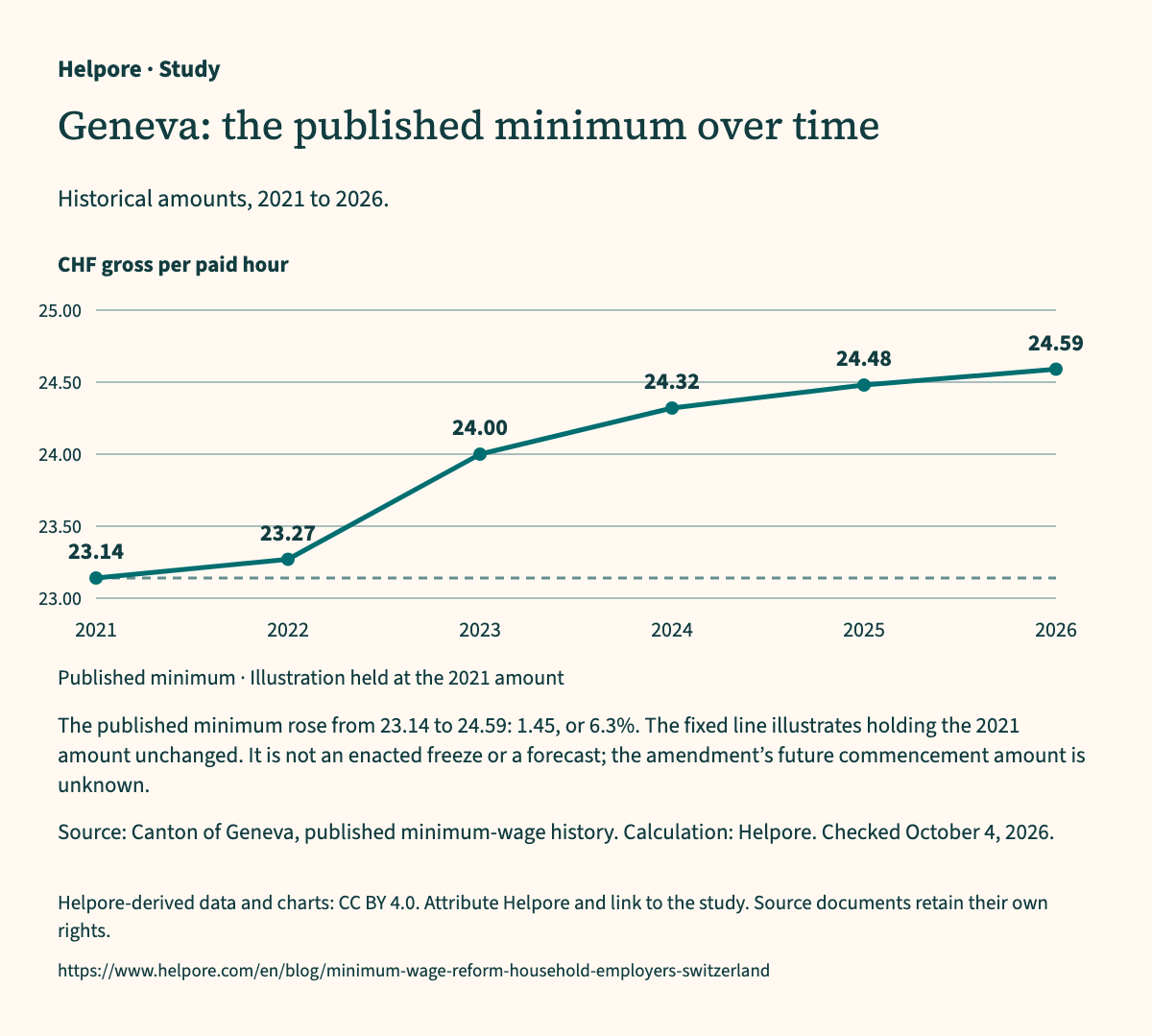
Geneva’s published minimum rose from CHF 23.14 in 2021 to CHF 24.59 in 2026. That is an increase of CHF 1.45, or 6.3 percent. Geneva’s published history
Holding the 2021 amount fixed would leave it CHF 1.45 below the published 2026 rate. This is a historical illustration; the amendment’s eventual commencement amount is unknown.
Study
Geneva: the published minimum over time
Historical amounts, 2021 to 2026.
CHF gross per paid hour
| Year | Published minimum | Illustration held at the 2021 amount |
|---|---|---|
| 2021 | 23.14 | 23.14 |
| 2022 | 23.27 | 23.14 |
| 2023 | 24.00 | 23.14 |
| 2024 | 24.32 | 23.14 |
| 2025 | 24.48 | 23.14 |
| 2026 | 24.59 | 23.14 |
The published minimum rose from 23.14 to 24.59: 1.45, or 6.3%. The fixed line illustrates holding the 2021 amount unchanged. It is not an enacted freeze or a forecast; the amendment’s future commencement amount is unknown.
Source: Canton of Geneva, published minimum-wage history. Calculation: Helpore. Checked October 4, 2026.
Show the data table
| Year | CHF gross per paid hour |
|---|---|
| 2021 | 23.14 |
| 2022 | 23.27 |
| 2023 | 24.00 |
| 2024 | 24.32 |
| 2025 | 24.48 |
| 2026 | 24.59 |
Two kinds of contract, two different legal mechanisms
A collective employment agreement, usually called a GAV in German, is negotiated by the relevant parties. A declaration making it generally binding extends its rules within its defined scope. Its minimum depends on the covered business, job category and conditions.
A standard employment contract, called a NAV in German, is issued by a public authority. The federal domestic-work NAV sets mandatory minimum wages for the household employment it covers. It is a different instrument from a generally binding GAV. Other employment conditions are also governed by the applicable cantonal standard contract and employment law.
The federal household minimum has a scope of its own. It applies from an average of five hours a week with the same employer and has exclusions, including certain training arrangements, family relationships and roles mainly responsible for childcare, including dayminders and babysitters. Geneva has separate household wage rules. Qualifications and relevant experience can require a higher minimum. Below the five-hour threshold, it does not follow that all other employment duties disappear. SECO’s scope and categories
Helpore reviewed SECO’s federal and cantonal lists of generally binding agreements dated 1 October 2026. The Basel household employment profile used in the numerical comparison is covered by the federal NAV rather than the cleaning-company GAV. Agency employment needs a separate assessment, even when the person works inside a private home. Federal list · Cantonal list
The referendum timetable
Parliament adopted the amendment on 19 June 2026. The referendum deadline is 8 October 2026. Unia has announced a hand-in for 7 October. The Federal Council determines commencement. Official amendment · Announced hand-in
The same cleaning work can fall under different wage rules. What matters is who employs the person and where the work is done.
Gilberto de la Fuente, Director at Helpore
Basel is a different current example
Basel-Stadt’s headline cantonal minimum is CHF 22.20 in 2026. Its scope contains an important exception: employment governed by a generally binding collective agreement, or a standard employment contract with minimum wages, is exempt. The canton states both exceptions in its minimum-wage FAQ.
That means the cantonal headline amount is not the minimum for every person cleaning a Basel home. For direct household employment covered by the federal domestic-work standard contract, the relevant unskilled minimum is CHF 20.35. For an employee in maintenance-cleaning category I at a company covered by the German-Swiss cleaning agreement, the base is CHF 21.40, with a mandatory thirteenth month under the agreement’s conditions.
Study
Basel: two employment relationships, two wage rules
Current rules for the selected 2026 profiles.
CHF gross per paid hour
Ordinary daytime cleaning, age 25 to 49, full-year employment and no exception. Household: unskilled, less than 4 years of relevant experience, at least 5 hours a week on average with the same employer; no agreed thirteenth month or higher wage. Company: maintenance cleaning I, at least 6 employees, generally binding agreement applies, employment longer than 3 months. Holiday and public-holiday uplifts, night/Sunday/overtime allowances, social contributions and expenses excluded. Gross wage comparison, not actual earnings or total employment protection.
Sources: SECO household rules, Basel-Stadt household contract and minimum-wage FAQ, German-Swiss cleaning agreement. Calculation: Helpore. Checked October 4, 2026.
Show the data table
| Basel: two employment relationships, two wage rules | CHF gross per paid hour | Base wage | Mandatory thirteenth month |
|---|---|---|---|
| Direct household employment | 20.35 | 20.35 | 0.00 |
| Covered cleaning company | 23.18 | 21.40 | 1.78 |
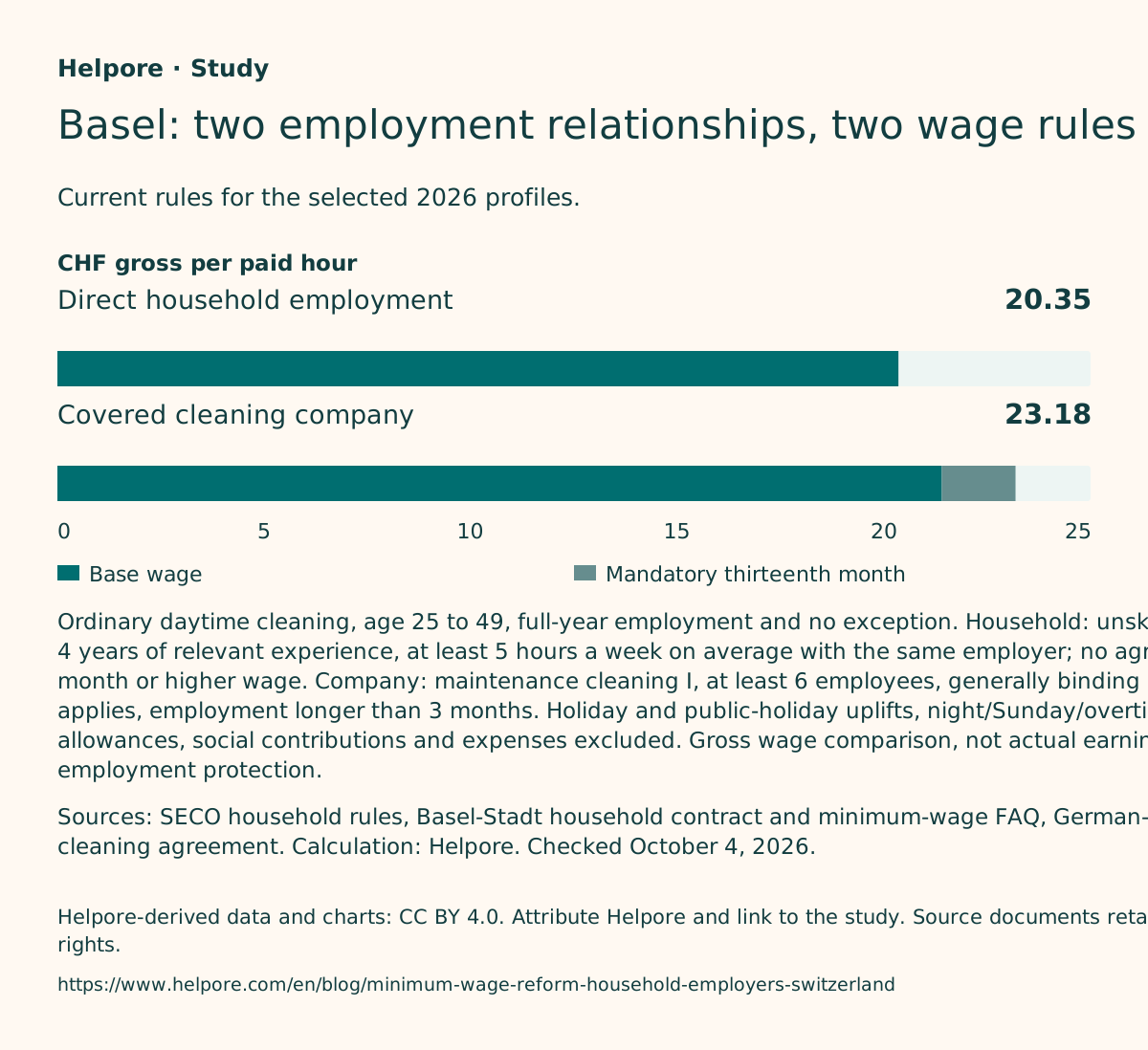
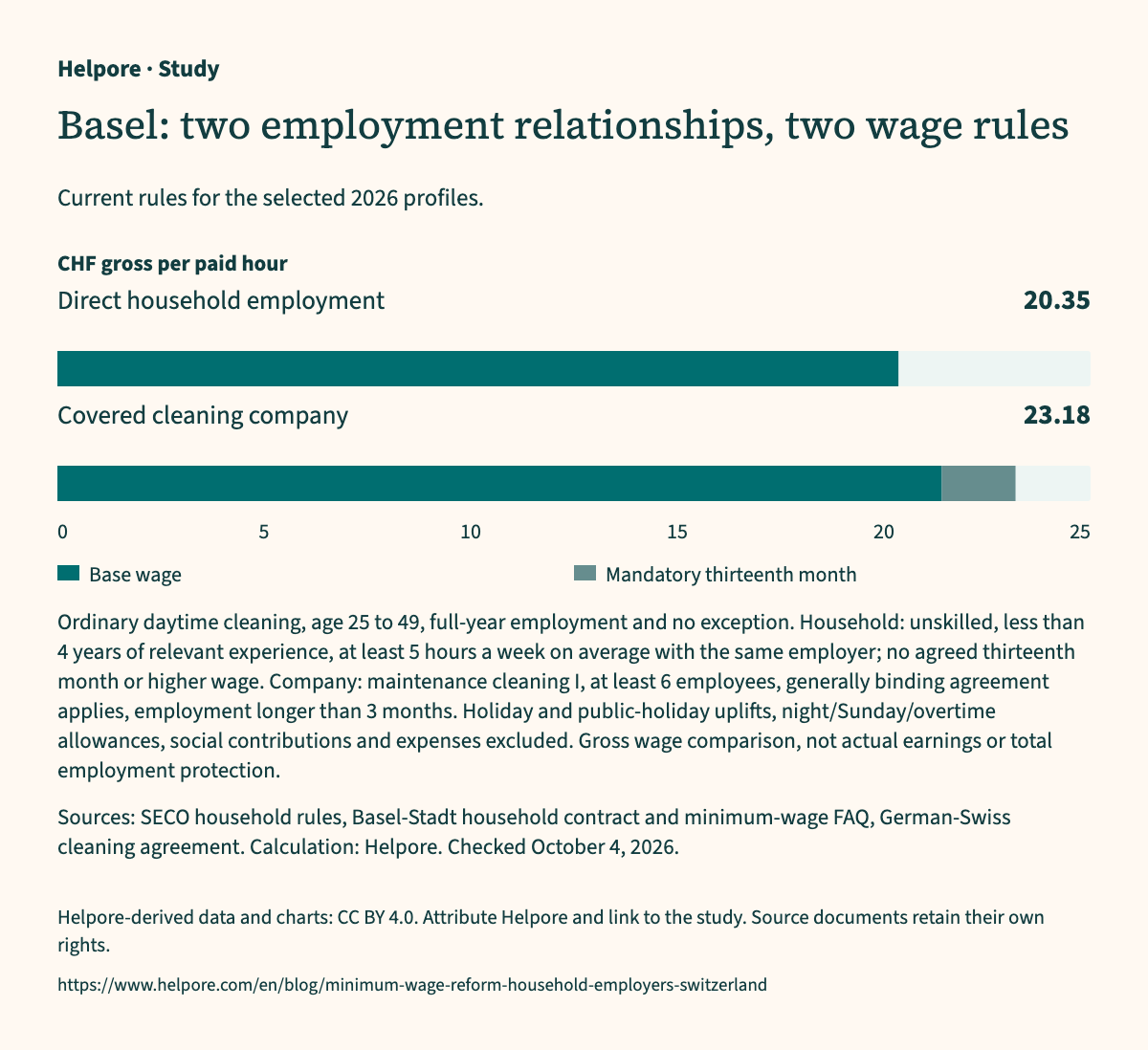
Profile and scope: the comparison uses a worker aged 25 to 49 doing ordinary daytime cleaning, full-year employment and no applicable exception. The direct household role averages at least five hours a week with the same employer and falls in the unskilled category with less than four years of relevant experience. The company employs at least six people and the role falls within the generally binding cleaning agreement, with employment lasting more than three months. These amounts exclude holiday and public-holiday uplifts. A higher agreed wage remains a separate matter. Federal household rules · Basel household contract · Cleaning agreement · Company coverage
This current Basel example does not demonstrate a higher household floor. It shows why local exceptions must be checked before applying the reform’s household distinction to another canton.
Other local rules cannot be inferred from Basel
Lucerne’s current municipal minimum is CHF 22.75. Its official guidance includes directly employed household cleaners and employment covered by a GAV. Basel’s NAV and GAV exclusions therefore cannot simply be transferred to Lucerne. The future federal transition remains a separate question. Lucerne’s published rate · City FAQ
Winterthur’s published municipal amount is CHF 23.00, but the city says the rules are not yet in force and a one-year transition will follow commencement. We do not assign a future effective wage or assume how a thirteenth month will count. City of Winterthur
Geneva has its own domestic-work rules. Neuchâtel publishes a general 2026 minimum of CHF 21.35, subject to its scope and exceptions. Ticino’s published household-sector amount is CHF 20.00; where the federal domestic-work NAV applies, its unskilled CHF 20.35 minimum must also be considered. Geneva household rules · Neuchâtel’s 2026 rate · Ticino’s decree
What a household should check
Start with the employment relationship. If the household employs the Helper directly, the household is responsible for applying the correct wage rules. If a company employs the person, establish which agreement and category cover that employment.
Then check the workplace, average hours with that employer, qualifications, relevant experience and any exception. Distinguish the gross base from a thirteenth month, paid leave and other pay components. A minimum-wage figure does not include all employer contributions, insurance or administration costs, and it is not the price a company charges its customers.
For practical employment steps, see hiring a Helper legally in Switzerland. Our guide to setting a household-work rate addresses the wider wage discussion.
Method and limits
Helpore checked the cited legal texts, authority guidance and agreement documents on 4 October 2026. We separated current rules from adopted rules awaiting commencement, then calculated comparable gross amounts for selected employment profiles. This is a document-based calculation, not a survey of employees, households or businesses.
Hourly normalization. A monthly salary is multiplied by the number of mandatory annual payments and divided by weekly hours × 52. Hairdressing uses 12 payments and 43 hours; the selected hospitality category uses 13 payments and 42 hours. Cleaning uses the hourly base multiplied by 13 ÷ 12. The Basel household profile has no automatic thirteenth month under the applicable federal and cantonal household rules. We assume no agreed extra payment or higher wage.
Paid hours and leave. The divisor describes the paid model year. It does not mean that a worker performs 52 weeks of work without holiday. Ordinary monthly pay continues during paid leave; the comparison excludes holiday and public-holiday uplifts and does not calculate a cost per hour actually worked.
Categories. The Basel cleaning model uses an adult aged 25 to 49 doing ordinary daytime cleaning. All numerical profiles assume full-year employment and the specified unskilled or entry category, with the Zurich reference limited to age 25 or older. Higher qualifications, experience, a different weekly-hours arrangement or an applicable exception can change the result. The cleaning model satisfies its thirteenth-month duration condition; the hospitality model does not end during probation.
Rounding. Displayed hourly amounts are rounded to the nearest cent after calculation. Annual comparisons use the unrounded results, so multiplying a rounded hourly difference by annual hours can produce a different total.
Annual comparison. The differences from the Zurich reference are CHF 3.61 for hairdressing, CHF 1.80 for hospitality and CHF 0.72 for maintenance cleaning per paid hour. Across their stated model years, those comparisons are CHF 8’080.40, CHF 3’928.60 and CHF 1’565.20, respectively. These are annualized comparisons of the stated amounts, not projected income losses. They use unrounded hourly results and the separate 43-hour or 42-hour weekly bases shown above.
Coverage. The numerical sector comparison uses the German-Swiss cleaning agreement. It must not be applied to French-speaking Switzerland or Ticino without checking their applicable rules. We do not convert the separate agency live-in care category into a comparable hourly figure here. We also do not infer future Winterthur or Lucerne wage reductions from their published municipal amounts.
What the study cannot establish. It does not measure actual pay, the number of affected workers, changes in employment or the overall protections of a job. It does not predict future wage agreements, inflation, commencement dates or a referendum outcome.
Data, charts and reuse
The downloadable calculation records the original amounts, category, formula, exact result, displayed result and source. Chart captions retain the status and scope so that the figures remain understandable outside this article.
Helpore’s derived data and charts are available under CC BY 4.0, with attribution to Helpore and a link to this study. The cited official documents retain their own rights. Suggested attribution: “Helpore, Minimum-wage referendum: a cleaner in a Zurich home would stay better protected than a hairdresser or a kitchen worker, 4 October 2026. Calculations from the cited official wage rules.”
Helpore publishes this analysis and offers household employment administration. The study takes no position on the referendum.
Sources
- Basel-Stadt: minimum-wage scope and exceptions. Explains the GAV and NAV exclusions behind the Basel comparison.
- SECO: federal domestic-work standard contract, 2026. Minimums, scope, exclusions and categories. Basel’s household contract supplies the cantonal employment terms.
- German-Swiss cleaning agreement. Covered maintenance-cleaning category, base and thirteenth month.
- Hairdressing agreement and hospitality rates for 2026. Category inputs and salary amounts.
- City of Zurich: municipal minimum. Published reference, exceptions and commencement status.
- Adopted federal amendment, 19 June 2026. Priority, transition and referendum deadline.
- National Council committee explanation, 14 April 2026. Parliamentary background on indexation; the adopted text is the legal reference.
- Geneva: minimum-wage amounts and historical series. Source of the historical illustration.
- SECO federal list and SECO cantonal list, 1 October 2026. Generally binding agreement coverage reviewed.
Data and charts
Reuse the calculations and charts with their source, scope and caption.
Download calculations (CSV)Helpore-derived data and charts: CC BY 4.0. Attribute Helpore and link to the study. Source documents retain their own rights.
Questions about the comparison
What would directly employed household cleaners keep under the reform?
If the amendment enters into force, cleaners directly employed by households and covered by Geneva’s or Neuchâtel’s cantonal minimum would retain its ordinary indexation. For affected jobs covered by a generally binding collective agreement, the transition preserves the amount at commencement without later cantonal indexation until the agreement’s minimum overtakes it. This is Helpore’s analysis of the adopted federal law and current cantonal rules, not a prediction of future amounts.
Does Basel’s cantonal minimum wage apply to every household employee?
No. Basel-Stadt exempts employment governed by a standard employment contract with minimum wages. In our example, an unskilled Helper employed directly by a household falls within the federal domestic-work contract and its CHF 20.35 hourly minimum in 2026. The federal rule requires at least five hours a week on average with the same employer and has further exceptions and higher qualification or experience categories.
Is Zurich’s CHF 23.90 municipal minimum already in force?
No, as of 4 October 2026. We use the published amount as a reference alongside selected 2026 collective-agreement rates. The comparison does not predict the future applicable wage or an individual pay cut.
Why include a thirteenth month in the comparison?
Some collective agreements require it. We spread that payment across the model year so that a monthly salary paid thirteen times can be compared with a salary paid twelve times or an hourly base. Holiday and public-holiday uplifts are excluded; paid-leave rights remain separate.
Does the reform let every employer pay a lower wage?
No. The amendment concerns minimum-wage provisions of generally binding collective agreements and includes a transition protecting certain existing amounts. A statutory minimum is also distinct from the wage agreed in an employment contract. Our calculations do not establish a right to reduce anyone’s pay.