There is a lot of home help work in Switzerland and not enough people doing it. The question that stops most people before they start is not whether the work exists. It is whether they are allowed to do it.
The honest answer is that it depends on your passport and on your situation right now, and that for a large number of people the answer is a straightforward yes with nothing to apply for. For one group there is no permit involved at all. This guide walks through every route, and the checker below gives you your own answer in three taps.
Check your own situation first
Rather than reading about seven permit types to find the one paragraph that applies to you, start here. Three questions, and you get your status, your next step, and what Helpore will ask you to upload.
If you already know you are good to go, you can create your free Helper profile now. It takes a few minutes, it costs nothing, and you set your own rate.
The short version
Four kinds of answer come out of that checker, and it is worth knowing what they look like before we go into detail.
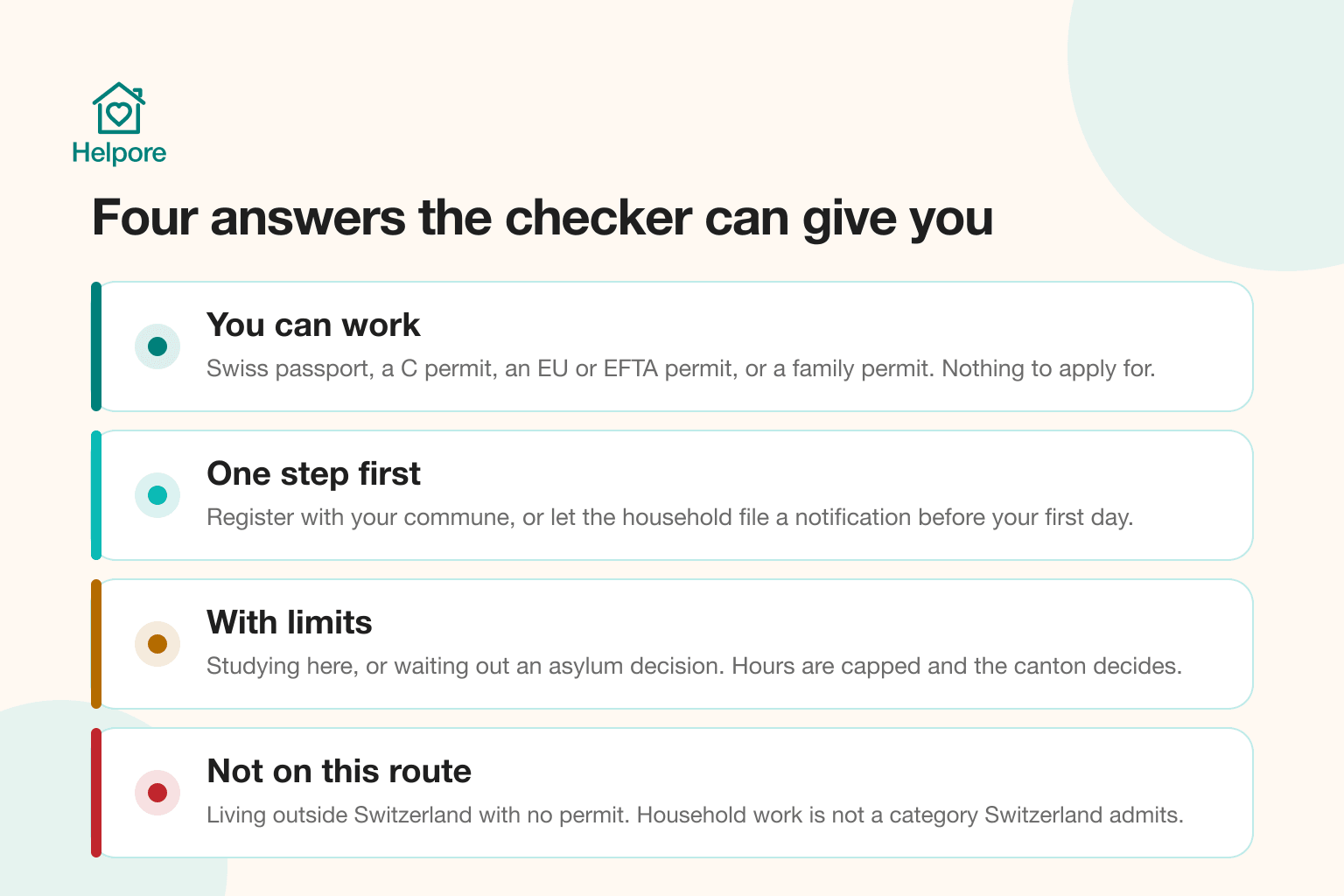
Most people who ask us this question land in the first two boxes. Very few land in the last one.
What the permit letters mean
Swiss permits are letters, and the letter tells you almost everything about what you may do.
| Permit | What it is | Household work |
|---|---|---|
| C | Settled residence, usually after five or ten years | Free access, like a Swiss citizen |
| B | Residence permit, renewable | Free if you are EU or EFTA, or if you hold it through family. Tied to one job if it was granted for that job |
| L | Short stay, under twelve months | Same logic as the B permit |
| G | Cross border commuter | Free access across the whole country |
| F | Provisionally admitted | Allowed in every canton and profession, employer notifies first |
| S | Protection status | Allowed, employer notifies first |
| N | Asylum application in progress | Possible after a waiting period, your canton decides |
EU and EFTA citizens: the easiest route in
If you hold a passport from an EU country, or from Norway, Iceland or Liechtenstein, the free movement agreement is on your side. Croatian citizens are included on the same terms in 2026, since Switzerland did not activate the safeguard clause for this year.
Under three months you need no permit at all
This is the part almost nobody knows. An EU or EFTA citizen who takes a job with a Swiss employer for up to three months in a calendar year is covered by the online notification procedure. No permit. No fee. No appointment at an office. The employer files a short online notification before your first day, and that is the whole formality.
Three months means ninety days across the calendar year, counted across all your Swiss work, not ninety days per employer. Once you pass that line you need a proper permit to carry on.
This matters for Helpore in a very practical way. If you are inside that window, we ask you for your passport or ID card and nothing else. We do not ask for a permit you are not required to hold. We also send you reminders three weeks, one week and one day before the window closes, so you have time to sort out a permit and stay bookable rather than being cut off by surprise.
Longer than three months, register with your commune
For anything beyond three months you register at your commune of residence. Do it within fourteen days of arriving and before you start work, taking your passport and your employment contract.
The key thing to understand is that this is a registration and not a competition. As an EU or EFTA citizen with a job in hand you have a right to the permit. Nobody weighs you against a quota or asks the household to prove they could not find someone else. A contract under twelve months gets you an L permit, and twelve months or open ended gets you a B.
Once you hold it, that permit is not chained to one employer. You can work for five households, add household work alongside another job, or change direction entirely. Tell your commune when your situation changes and carry on.
Living across the border
If you live in the EU or EFTA border area and travel in, the G permit covers you. Cross border commuters from the EU and EFTA are no longer restricted to the border region and can work anywhere in Switzerland, as long as your main home stays abroad and you return to it at least once a week.
Already living here on a family permit
A B permit held through marriage or family reunification with a Swiss citizen, a C permit holder or an EU or EFTA citizen carries the right to work with it. Any job, any canton, as many employers as you like. There is nothing extra to apply for. Check that your permit card does not carry an employment restriction, keep it renewed, and you are free to work.
This is the route a lot of people overlook. They assume that because they came to Switzerland for family reasons rather than for a job, work is somehow off limits. It is not.
When your permit is attached to one employer
If you came to Switzerland from outside the EU and EFTA for a specific job, your permit covers that job. Adding household work on the side, or moving into it, is a change your canton has to approve before you start.
Ask your cantonal migration or labour market office first. Do not take the hours and sort out the paperwork afterwards, because working outside the terms of your permit puts the permit itself at risk. The same applies to British citizens who received a permit for a specific role after 2021, since Brexit moved the UK into the third country rules.
Protection status and asylum
People with an F permit have been able to work in every canton and every profession since 2019. There is no special tax on the wage and no quota in the way. Your employer notifies the cantonal authority before your first day.
People with S protection status may take paid work too. The step is a notification rather than a competitive application, and it has to be made before you start, again if you change employer, and again if you stop.
For both of those, the employer is the household that books you, and Helpore handles the filings on their behalf. It is not paperwork you have to work out on your own.
People with an N permit, waiting on an asylum decision, can be allowed to work once a waiting period of at least three months from the application has passed. This one needs cantonal authorisation, some cantons restrict which sectors are open, and it is not possible while you are living in a federal asylum centre. Ask your cantonal authority and get the answer in writing before you accept hours.
Studying here
Students from outside the EU and EFTA may work up to fifteen hours a week during term and full time in the holidays, but only from six months after the course starts, with the school confirming the work will not slow your studies and the canton authorising it.
EU and EFTA students can work alongside their studies with less friction, provided studying stays the main activity. Around fifteen hours a week during term is the usual line.
Either way, household work suits a student timetable well, because you set your own availability rather than being handed a shift pattern. Just plan your bookings inside the limit written on your own permit.
If you live outside the EU and EFTA with no Swiss permit
This is the one honest no in the guide, and it is better to hear it plainly than to lose money finding out.
Switzerland admits third country nationals to its labour market only as managers, specialists and other qualified workers, under strict quotas, and only where nobody from Switzerland or the EU and EFTA could fill the role. Cleaning, childcare and home care are not in those categories. No Swiss household can sponsor you for this work, whatever anyone tells you.
If someone offers to arrange a Swiss permit or a household job for a fee, that is a warning sign, not an opportunity. If your situation changes later, through family in Switzerland for example, come back and run the checker again.
What Helpore asks you to upload
We ask for what the law actually requires of you and nothing beyond it.
- Everyone uploads an ID card or passport.
- Most Helpers also upload a photo of their Swiss permit.
- Swiss citizens upload no permit document, because there is none to hold.
- EU and EFTA citizens inside the ninety day window upload no permit document either, and get advance warning before the window closes.
Your documents are checked by a person, not left sitting in a queue, and you are told what is missing rather than left guessing.
Once you are cleared to work, the rest is yours
Getting the permit question settled is the hard part. What happens next on Helpore is deliberately simple.
You set your own gross hourly rate. You keep your full wage, because Helpore does not take a cut of it. You choose your services, your availability and the area you are willing to travel to, and you get booked automatically when a household nearby matches what you offer. You are not bidding for jobs or refreshing a list of adverts hoping to be picked.
Every hour is declared, with AHV, accident cover and a proper contract, which is the difference between work that counts towards your pension and work that leaves no trace. Our guide on cash in hand versus declared work sets out what is really at stake there.
Joining is free. If you know other good people, your referral link earns you a referral reward once someone you refer completes the qualifying hours with Helpore.
Worth reading next:
- How much you actually take home as a cleaner or nanny, with an estimator for your own numbers
- How much you should charge in 2026
- How to find cleaning, nanny and home help work on your own terms
- Holiday pay on an hourly wage, the 8.33% that belongs on top of your rate
Ready when you are: create your free Helper profile, set your rate, and get booked.
Official sources
- SEM FAQ on free movement for EU and EFTA citizens: work under and over three months, registration and family reunification.
- SEM notification procedure for short term work: who must be notified, who files and the deadlines.
- SEM rules for non EU and EFTA nationals: qualification, quota and labour market requirements.
- SEM information on permit F and protection status S: access to employment and the employer notification duty.
- SEM working FAQ: student work and family permit conditions.
This guide is general information about Swiss permit rules, not legal advice. Permits are granted and applied by your canton, and your own case can differ. Your cantonal migration office has the final word.