More recipients, and more per old age pension
In December 2025, 80’386 people in Switzerland received a helplessness allowance from the AHV, 37.3% more than the 58’569 of December 2015, according to the Federal Social Insurance Office (BSV).
The helplessness allowance (Hilflosenentschädigung, allocation pour impotent, assegno per grandi invalidi) of the AHV, the federal old age and survivors' insurance, is paid to people who need regular help from others with everyday acts. Examples are getting up, dressing, going to the toilet, eating and personal hygiene. It is also paid to people who need constant care or personal supervision. It has three degrees: light, medium and severe.
Over the same years the number of old age pensions grew 19.7%, from 1’518’578 to 1’818’158. So the number of recipients per 1’000 old age pensions rose from 38.6 in 2015 to 44.2 in 2025.
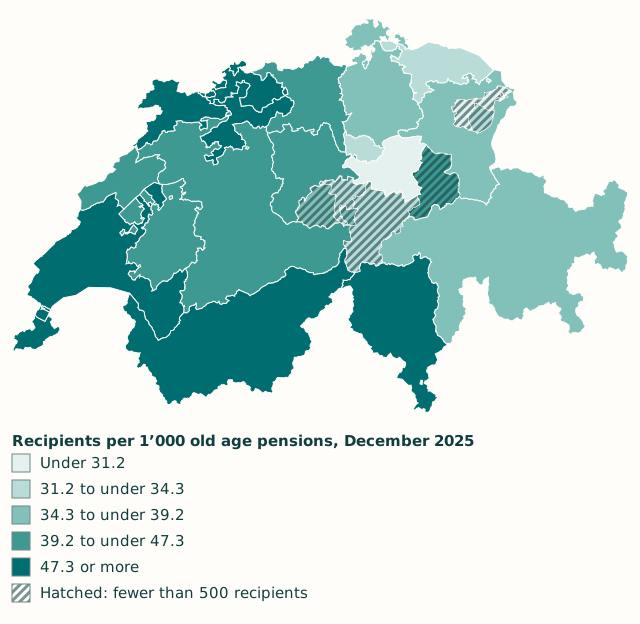
In December 2025, this rate ranged from 86.8 in Ticino to 28.8 in Appenzell Ausserrhoden. Appenzell Ausserrhoden counted fewer than 500 recipients, so a few people more or less move its rate.
- Recipients, December 202580’38658’569 in December 2015
- More recipients since 201537.3%Old age pensions grew 19.7%
- Recipients per 1’000 old age pensions44.238.6 in 2015
- Highest and lowest cantonTicino 86.8 · Appenzell Ausserrhoden 28.8Per 1’000 old age pensions. Appenzell Ausserrhoden counted fewer than 500 recipients.
Canton by canton
By canton
Pick a year and a measure. Select a canton on the map or in the list to see its three degrees and its line from 2015 to 2025.
- Under 31.2
- 31.2 to under 34.3
- 34.3 to under 39.2
- 39.2 to under 47.3
- 47.3 or more
- Hatched: fewer than 500 recipients
Recipients per 1’000 old age pensions, December 2025
Use the arrow keys to move between cantons. Press Enter to open a canton.
Switzerland
December 2025
80’386 recipients
44.2 per 1’000 old age pensions
View the complete 26 canton tableHide the complete canton table
| Canton | Recipients | Recipients per 1’000 old age pensions | Share of the light degree | Change in the rate since 2015 |
|---|---|---|---|---|
| Zurich | 11’170 | 38.3 | 30.5% | rose by 6.3 |
| Bern | 9’967 | 40.2 | 36.9% | rose by 6.8 |
| Lucerne | 3’535 | 40.9 | 33.9% | fell by 4.5 |
| Uri * | 281 | 31.5 | 25.6% | fell by 4.9 |
| Schwyz | 1’069 | 31.0 | 28.9% | fell by 3.9 |
| Obwalden * | 321 | 36.4 | 35.2% | fell by 1.1 |
| Nidwalden * | 348 | 32.3 | 33.3% | fell by 4.0 |
| Glarus * | 378 | 39.9 | 20.6% | rose by 7.6 |
| Zug | 851 | 33.1 | 29.5% | rose by 1.8 |
| Fribourg | 2’618 | 42.5 | 29.1% | rose by 2.3 |
| Solothurn | 3’149 | 49.1 | 36.3% | rose by 4.2 |
| Basel-Stadt | 2’294 | 57.0 | 30.8% | rose by 3.9 |
| Basel-Landschaft | 3’425 | 47.8 | 29.3% | rose by 10.4 |
| Schaffhausen | 746 | 36.5 | 31.9% | rose by 7.8 |
| Appenzell Ausserrhoden * | 373 | 28.8 | 25.2% | fell by 3.0 |
| Appenzell Innerrhoden * | 119 | 32.0 | 26.9% | fell by 3.8 |
| St. Gallen | 3’933 | 36.0 | 29.6% | rose by 2.6 |
| Grisons | 1’711 | 34.6 | 35.0% | rose by 5.2 |
| Aargau | 5’784 | 39.6 | 34.9% | rose by 6.7 |
| Thurgau | 1’893 | 31.2 | 30.3% | rose by 3.6 |
| Ticino | 7’495 | 86.8 | 21.4% | rose by 21.2 |
| Vaud | 7’473 | 51.0 | 32.1% | rose by 6.0 |
| Valais | 4’501 | 57.3 | 29.3% | rose by 4.1 |
| Neuchâtel | 1’690 | 45.1 | 36.4% | rose by 13.1 |
| Geneva | 4’152 | 47.3 | 32.9% | rose by 7.1 |
| Jura | 1’110 | 62.7 | 30.8% | rose by 10.6 |
| Switzerland | 80’386 | 44.2 | 31.3% | rose by 5.6 |
Change in the rate: recipients per 1’000 old age pensions in 2025 minus those in 2015.
* Fewer than 500 recipients in 2025.
In December 2025, the highest rates per 1’000 old age pensions were in Ticino 86.8, Jura 62.7, Valais 57.3, Basel-Stadt 57.0 and Vaud 51.0. The lowest were in Appenzell Ausserrhoden 28.8, Schwyz 31.0, Thurgau 31.2, Uri 31.5 and Appenzell Innerrhoden 32.0.
From 2015 to 2025, the number of recipients rose in all 26 cantons. Counted in recipients per 1’000 old age pensions, the rate rose most in Ticino 21.2, Neuchâtel 13.1, Jura 10.6 and Basel-Landschaft 10.4. In Ticino it went from 65.6 to 86.8. The rate fell in 7 cantons. The largest falls were in Uri 4.9, Lucerne 4.5, Nidwalden 4.0, Schwyz 3.9 and Appenzell Innerrhoden 3.8. It also fell in Appenzell Ausserrhoden 3.0 and Obwalden 1.1.
Uri, Obwalden, Nidwalden, Glarus, Appenzell Ausserrhoden and Appenzell Innerrhoden each counted fewer than 500 recipients in December 2025, so read their figures with care.
The light degree grew most, the severe degree fell
From December 2015 to December 2025, recipients of the light degree rose 70.3%, from 14’795 to 25’196. Recipients of the medium degree rose 53.4%, from 23’857 to 36’586. Recipients of the severe degree fell 6.6%, from 19’917 to 18’604.
So the mix changed. The light degree went from 25.3% to 31.3% of all recipients, the medium degree from 40.7% to 45.5%, and the severe degree from 34.0% to 23.1%.
In 2025, the light degree's share was smallest in Glarus (20.6%) and Ticino (21.4%), and largest in Bern (36.9%). Glarus counted fewer than 500 recipients.
- Light degree: 25’196 (31.3%)
- Medium degree: 36’586 (45.5%)
- Severe degree: 18’604 (23.1%)
- All degrees: 80’386
| Recipients | Light degree | Medium degree | Severe degree |
|---|---|---|---|
| 2015 | Light degree: 14’795 (25.3%) | Medium degree: 23’857 (40.7%) | Severe degree: 19’917 (34.0%) |
| 2016 | Light degree: 15’647 (25.7%) | Medium degree: 25’065 (41.1%) | Severe degree: 20’277 (33.2%) |
| 2017 | Light degree: 16’565 (26.3%) | Medium degree: 26’377 (41.9%) | Severe degree: 20’012 (31.8%) |
| 2018 | Light degree: 17’408 (27.1%) | Medium degree: 27’222 (42.4%) | Severe degree: 19’587 (30.5%) |
| 2019 | Light degree: 18’415 (27.6%) | Medium degree: 28’713 (43.0%) | Severe degree: 19’708 (29.5%) |
| 2020 | Light degree: 18’959 (28.4%) | Medium degree: 28’943 (43.3%) | Severe degree: 18’946 (28.3%) |
| 2021 | Light degree: 19’618 (29.4%) | Medium degree: 28’963 (43.4%) | Severe degree: 18’190 (27.2%) |
| 2022 | Light degree: 20’047 (29.9%) | Medium degree: 29’521 (44.0%) | Severe degree: 17’562 (26.2%) |
| 2023 | Light degree: 21’178 (30.3%) | Medium degree: 30’957 (44.3%) | Severe degree: 17’715 (25.4%) |
| 2024 | Light degree: 23’462 (30.8%) | Medium degree: 34’144 (44.8%) | Severe degree: 18’590 (24.4%) |
| 2025 | Light degree: 25’196 (31.3%) | Medium degree: 36’586 (45.5%) | Severe degree: 18’604 (23.1%) |
The largest yearly rise came in 2024
From 2015 to 2023, the national rate stayed between 38.6 and 41.0 recipients per 1’000 old age pensions. From December 2023 to December 2024, the number of recipients rose 9.1%, from 69’850 to 76’196. That was the largest yearly rise from 2015 to 2025. In 2025 it rose another 5.5%, to 80’386. The rate went to 42.6 in 2024 and to 44.2 in 2025.
The law changed in the same year. Since 1 January 2024, with the AHV 21 reform, the waiting period for the helplessness allowance of the AHV is 6 months instead of 12 (Art. 43bis Abs. 2 AHVG). The waiting period is how long the helplessness must have lasted without a break before the person has a claim. The reform set no transitional rule for it. In the disability insurance (IV), the waiting period stays 12 months.
AHV 21 also changed two other rules of the allowance. A claim now requires the whole old age pension; drawing only part of it early is not enough. And a person who received a helplessness allowance from the IV keeps it at AHV age if it was still paid at the end of the month in which they reached the reference age. The reference age is the age at which the regular AHV old age pension starts. The same applies if the IV allowance was paid until they began to draw a whole pension early.
This study does not treat the change in the law as the cause of the rise.
What the allowance is and how much it pays
The Federal Social Insurance Office describes the allowance as a cash benefit for the costs of people who regularly need help from others with everyday acts. According to leaflet 3.01 of the AHV and IV information centre, it does not depend on income or assets.
A person can claim the allowance if they:
- draw the whole old age pension or supplementary benefits;
- are domiciled and habitually resident in Switzerland, so people who live abroad have no claim;
- receive no helplessness allowance from accident or military insurance;
- have been helpless without a break for the waiting period of 6 months.
The amount depends on the degree. It is a fifth of the minimum full old age pension for the light degree, half for the medium degree and four fifths for the severe degree (Art. 43bis Abs. 3 AHVG). In 2026, the minimum full old age pension is CHF 1’260 a month, so the allowance is:
- light degree: CHF 252 a month;
- medium degree: CHF 630 a month;
- severe degree: CHF 1’008 a month.
From 1 January 2027, the minimum full old age pension is CHF 1’280. The allowance then comes to CHF 256, CHF 640 and CHF 1’024 a month. The study calculated these amounts from Art. 43bis Abs. 3 AHVG. The AHV leaflet does not print them yet.
The AHV pays the light degree to people who live at home, not in a care home. The medium and severe degrees are paid at the same amount at home and in a care home.
A person who received a helplessness allowance from the IV keeps at least the same amount at AHV age. Someone who draws a part of the old age pension early keeps the IV allowance. A person who puts off drawing the old age pension (defers it) loses the IV allowance and this guarantee of its amount.
In December 2025, the AHV paid CHF 52.2 million in helplessness allowances, an average of CHF 649 per recipient in that month. The sum is about CHF 4 million more than the recipients of each degree times the AHV amount for that degree. The statistics give only the total paid, not the sum per degree. That total can include back payments and the higher IV amounts that former IV recipients keep. So the average cannot be worked out from the amounts per degree above.
What the figures do not show
- The figures count allowances paid, not need. People who could claim and never apply are not in them.
- They do not say whether a recipient lives at home or in a care home. The light degree gives a hint, because the AHV pays it to people at home.
- A rate per 1’000 old age pensions is not a rate per person past the reference age. A deferred pension is not in the pension count, while a pension drawn early is.
- The statistics do not show why the number of recipients rose or why cantons differ. Differences between cantons may reflect age structure, health, the number of care home places, how often people apply and how cantons inform.
Claiming the allowance, and paying someone to help at home
On 30 October 2026, the 9 cantons of the Alliance intercantonale de la proche aidance marked the day for family carers. They are Valais, Geneva, Fribourg, Jura, Bern, Graubünden, Ticino, Neuchâtel and Vaud.
How to claim the allowance
The claim form 009.002 is on the website of the AHV and IV information centre. Send it to the compensation office that pays the old age pension (Art. 125bis AHVV). That office passes it to the IV office, which assesses the degree of helplessness. Form 009.002, claim for a helplessness allowance of the AHV
Paying someone to help at home
A household that pays someone to help at home is that person's employer. The employer is the household where the Helper works and that decides what work is done there, when and how. If a daughter or son organises and pays for help in a parent's own home, the parent's household is the employer.
A Helper does the non medical work around the care, such as shopping, cooking, cleaning and company. Nursing work stays with approved care providers and qualified nurses.
As the employer, your household registers with the compensation office of its canton. From 1 January after the Helper turns 17, your household owes AHV contributions on wages from the first franc, with two exceptions. Up to 31 December of the year the Helper turns 25, wages of at most CHF 750 a year from your household are free of contributions unless the Helper asks to pay. From the reference age, the first CHF 16’800 a year (CHF 1’400 per month worked) is free of contributions unless the Helper gives up this allowance. From the reference age, no unemployment insurance contributions are due. Cover for accidents at work is required from the day the work starts. Give your Helper a payslip with every payment. The employer check shows which of your duties are in place and which are still to do.
If your Helper already works for you, Helpore has two plans. With Helpore Admin Light, the payslips and documents are ready every month, and you register, file and pay yourself. With Helpore Admin, registration, insurance, payroll and payments are done in your name, with one bill a month. Helpore Admin Light and Helpore Admin are optional, and your household stays the employer. Your Helper does not need a public profile or a Helpore account.
The IV assistance contribution study covers help paid through the disability insurance, and the guide for family carers walks through hiring a Helper step by step.
“Nursing stays with nurses. A Helper can take on the shopping, the cooking and the cleaning, so the person who cares at home gets a few hours of their own.”
Method and data
The figures come from the AHV statistics of the Federal Social Insurance Office (BSV), published in the PxWeb database of the Federal Statistical Office. The recipients, the degrees and the amount paid are from table px-x-1305000000_201, which counts the helplessness allowances of the AHV in December by canton, degree, sex and year. The national values are the same in table px-x-1305000000_202, which counts the same register by age class. The old age pensions are from table px-x-1305000000_102, pension type old age pension, all nationalities and both sexes. Tables px-x-1305000000_201 and px-x-1305000000_102 show an older update date in their metadata, although they hold data to 2025.
Each figure counts December of its year. Two years are two separate December counts, not the same people followed over time. Someone who received the allowance earlier in a year but not in December is not counted. The canton is the canton given in table px-x-1305000000_201; its metadata does not say whether that is the canton of residence or the canton of the paying office. In every year, the recipients of the 26 cantons add up to the Swiss total, and so do their old age pensions.
The rate is the number of recipients divided by the number of old age pensions in the same canton and year, times 1’000, rounded to one decimal. The change in the rate is the 2025 rate minus the 2015 rate, computed before rounding. A change in % is the later figure minus the earlier figure, divided by the earlier figure, rounded to one decimal. The share of a degree is its recipients divided by all recipients.
The amount is the sum paid in December, in thousand francs, as the table records it. The study does not recompute it from the amounts per degree. The average per recipient is the December sum divided by the December recipients.
A canton with fewer than 500 recipients in a year is marked as small numbers for that year.
The study analyses 2015 to 2025; the table holds earlier years too. The amounts of the allowance come from Art. 43bis Abs. 3 and Art. 34 Abs. 5 AHVG in the versions named in the sources.
Use the study data
The files use the same federal figures as the article, the canton map and the chart.
- Download the data (CSV)CSV · 16 KB
- Download the data definitionsMD · 1 KB
- Download the methodMD · 3 KB
- Download the canton map (SVG)SVG · 50 KB
Source: Federal Social Insurance Office (BSV), AHV statistics.
The study text, the datasets we built and the charts we drew are under CC BY 4.0, so you may reuse them with attribution. The official source material stays under its own terms.
Frequently asked questions
How many people receive a helplessness allowance from the AHV?
In December 2025, 80’386 people received one, 37.3% more than in December 2015. Of them, 25’196 received the light degree, 36’586 the medium degree and 18’604 the severe degree. The figures come from the AHV statistics of the Federal Social Insurance Office (BSV).
How much is the AHV helplessness allowance in 2026?
CHF 252 a month for the light degree, CHF 630 for the medium degree and CHF 1’008 for the severe degree. That is a fifth, half and four fifths of the minimum full old age pension of CHF 1’260 a month. From 1 January 2027, the minimum full old age pension is CHF 1’280, so the law gives CHF 256, CHF 640 and CHF 1’024 a month.
Can I get the light degree in a care home?
No. The AHV pays the light degree to people who live at home. The medium and severe degrees are paid at the same amount at home and in a care home.
What is the helplessness allowance meant to cover?
The Federal Social Insurance Office describes it as a cash benefit for the costs of people who regularly need help from others with everyday acts. According to leaflet 3.01 of the AHV and IV information centre, it does not depend on income or assets.
Which canton has the most recipients per old age pension?
Ticino, with 86.8 recipients per 1’000 old age pensions in December 2025, against 44.2 for Switzerland.
Where do I find the form to claim the AHV helplessness allowance?
The claim form 009.002 is on the website of the AHV and IV information centre. Send it to the compensation office that pays the old age pension (Art. 125bis AHVV). That office passes it to the IV office, which assesses the degree of helplessness.
How long must the need for help last before the AHV pays?
Since 1 January 2024, with the AHV 21 reform, the helplessness must have lasted without a break for 6 months instead of 12 (Art. 43bis Abs. 2 AHVG). In the disability insurance (IV), the waiting period stays 12 months.
Sources
- BSV, AHV statistics, "Hilflosenentschädigungen der AHV im Dezember nach Beobachtungseinheit, Kanton, Hilflosigkeitsgrad, Geschlecht und Jahr", PxWeb table px-x-1305000000_201, in German. https://www.pxweb.bfs.admin.ch/pxweb/de/px-x-1305000000_201/px-x-1305000000_201/px-x-1305000000_201.px (API https://www.pxweb.bfs.admin.ch/api/v1/de/px-x-1305000000_201/px-x-1305000000_201.px). Read 29 October 2026.
- BSV, AHV statistics, helplessness allowances of the AHV by age class, PxWeb table px-x-1305000000_202, in German. https://www.pxweb.bfs.admin.ch/api/v1/de/px-x-1305000000_202/px-x-1305000000_202.px. Read 29 October 2026.
- BSV, AHV statistics, "Anzahl AHV-Renten, Rentensumme und Mittelwert in der Schweiz im Dezember nach Beobachtungseinheit, Rententyp, Kanton, Staatsangehörigkeit (Kategorie), Geschlecht und Jahr", PxWeb table px-x-1305000000_102, in German. https://www.pxweb.bfs.admin.ch/api/v1/de/px-x-1305000000_102/px-x-1305000000_102.px. Read 29 October 2026.
- Federal Act on Old-Age and Survivors' Insurance (AHVG, SR 831.10), Art. 34 Abs. 5 and Art. 43bis, version of 1 January 2026. https://www.fedlex.admin.ch/eli/cc/63/837_843_843/20260101/de. Read 29 October 2026.
- AHVG, Art. 43bis Abs. 2, versions of 1 January 2023 and 1 January 2024. https://www.fedlex.admin.ch/eli/cc/63/837_843_843/20230101/de and https://www.fedlex.admin.ch/eli/cc/63/837_843_843/20240101/de. Read 29 October 2026.
- Ordinance of 2 October 2026 on the adjustments to wage and price developments in the AHV, IV and EO (AS 2026 542), Art. 3: the minimum full old age pension from 1 January 2027, in German. https://www.fedlex.admin.ch/eli/oc/2026/542/de. Read 31 October 2026.
- Federal Act on the General Part of Social Insurance Law (ATSG, SR 830.1), Art. 9. https://www.fedlex.admin.ch/eli/cc/2002/510/de. Read 29 October 2026.
- Ordinance on Old-Age and Survivors' Insurance (AHVV), Art. 69bis, 69quater and 125bis, version of 1 January 2026. https://www.fedlex.admin.ch/eli/cc/63/1185_1183_1185/20260101/de. Read 29 October 2026.
- AHV and IV information centre, leaflets 2.01 (contributions) and 2.06 (domestic work), as of 1 January 2026: the start of contributions (AHVG Art. 3), the small wage exemption for young Helpers (AHVV Art. 34d) and the allowance from the reference age (AHVV Art. 6quater), in German. https://www.ahv-iv.ch/p/2.01.d and https://www.ahv-iv.ch/p/2.06.d. Read 31 October 2026.
- AHV and IV information centre, leaflet 3.01, old age pensions and helplessness allowances of the AHV, as of 1 January 2026, in German. https://www.ahv-iv.ch/p/3.01.d. Read 29 October 2026.
- AHV and IV information centre, helplessness allowances of the AHV, in German. https://www.ahv-iv.ch/de/Sozialversicherungen/Alters-und-Hinterlassenenversicherung-AHV/Hilflosenentsch%C3%A4digungen. Read 29 October 2026.
- AHV and IV information centre, form 009.002, claim for a helplessness allowance of the AHV, in German. https://www.ahv-iv.ch/p/009.002.d. Read 29 October 2026.
- BSV, FAQ "Was ist die Hilflosenentschädigung?", in German. https://faq.bsv.admin.ch/de/betreuung-von-angehoerigen/was-ist-die-hilflosenentschaedigung. Read 29 October 2026.
- BSV, AHV 21, in German. https://www.bsv.admin.ch/de/ahv-21. Read 29 October 2026.
- BSV, press release of 2 October 2026, "AHV/IV-Minimalrente steigt um 20 Franken", in German. https://www.bsv.admin.ch/de/newnsb/BqB41FVYi5FB. Read 29 October 2026.
- Canton of Vaud, press release of 19 October 2026, "Proches aidants: reconnaître ce rôle, faire connaître les soutiens", in French. https://www.vd.ch/actualites/communiques-de-presse-de-letat-de-vaud/detail/communique/proches-aidants-reconnaitre-ce-role-faire-connaitre-les-soutiens. Read 31 October 2026.