Swiss household employment · 2025
Nearly one in five Swiss household employees works on call
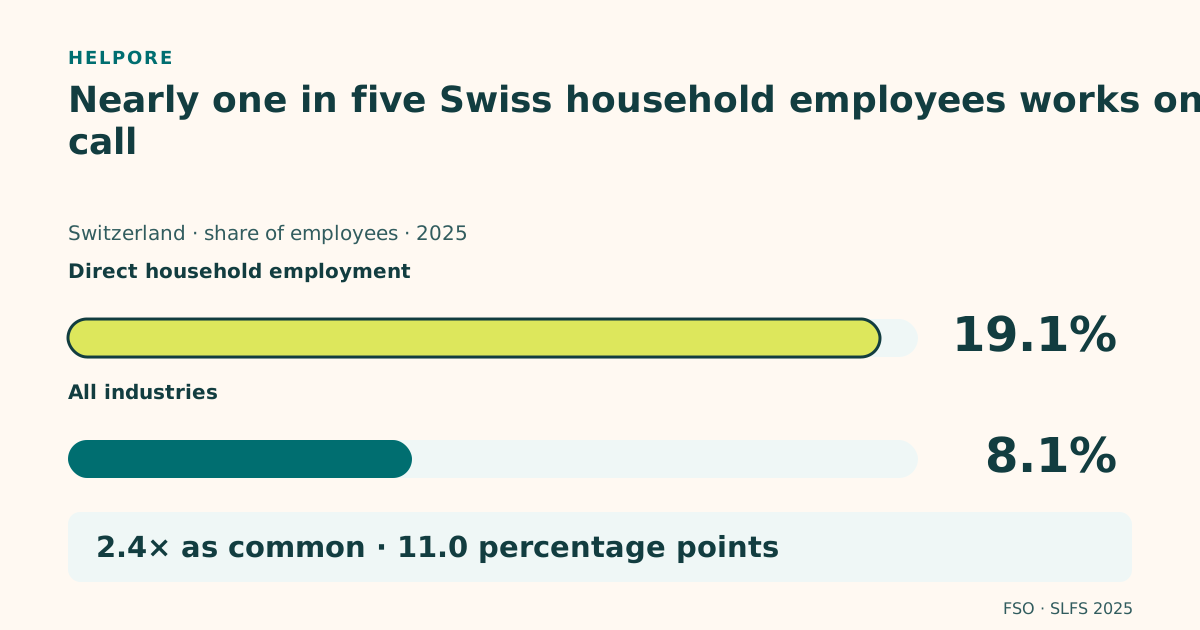
In 2025, 19.1% of employees hired directly by private households worked on call, against 8.1% across all industries. That is 2.4 times as common.
What on call means
On call work means an employee works only when called in by the employer.
Switzerland · share of employees · 2025
On call work is 2.4 times as common in direct household employment
2.4×as common
19.1% of employees in direct household employment worked on call, compared with 8.1% across all industries. Both bars use the same zero to 20% scale.
| Employment scope | Share working on call |
|---|---|
| Direct household employment | 19.1% |
| All industries | 8.1% |
That is an 11.0 percentage point gap. Source: Swiss Federal Statistical Office (FSO), Swiss Labour Force Survey (SLFS) 2025.
A national gap in plain numbers
That means about 19 in every 100 employees in direct household employment, compared with about 8 in every 100 employees across all industries.
For households that employ someone directly, the figures raise practical questions: when may work be requested, how will the hours be recorded and how will that time be paid?
Who the figures include
The official category is broader than cleaning. It covers domestic personnel employed directly by private households, including cleaners, babysitters, gardeners and personal assistants. It excludes people doing similar work through a company or as independent providers.
Clarity before the first shift
Households may need flexibility. Before work starts, both sides should agree when work may be requested, how hours will be recorded and how the employee will be paid. A household that hires someone directly is the employer.
Helpore’s view
“Households may need flexibility, but the person doing the work must know what has been agreed. A household employer should write down when work may be requested, how each hour is recorded and what will be paid.”
Three questions, answered
What does on call work mean?
It means an employee works only when called in by the employer. The FSO figure measures how common that arrangement is, not the exact terms of each job.
Who counts as a household employee in this study?
The figure covers domestic personnel employed directly by private households, including cleaners, babysitters, gardeners and personal assistants. It excludes staff supplied by companies and independent providers.
How much more common is on call work in household employment?
It was 2.4 times as common in direct household employment as across all industries in 2025, a gap of 11.0 percentage points.
How we calculated the comparison
The figures come from the Swiss Labour Force Survey (SLFS) for 2025 of the Swiss Federal Statistical Office (FSO), published on 18 May 2026. The survey covers Switzerland's permanent resident population aged 15 and over. These industry estimates concern employees excluding apprentices. We calculated the ratio and gap from the unrounded official cells, then rounded the results for display. The household category covers private households as employers of domestic personnel. Company supplied workers and independent providers are classified elsewhere. The statistic describes how common on call arrangements are, not the terms of individual jobs.
Official sources
Swiss Federal Statistical Office (FSO) · Swiss Labour Force Survey (SLFS) 2025